
Consents Are Up, Margins Are Thin: Why Project Monitoring Matters More In 2027
Havelock North · Nov 4, 2026
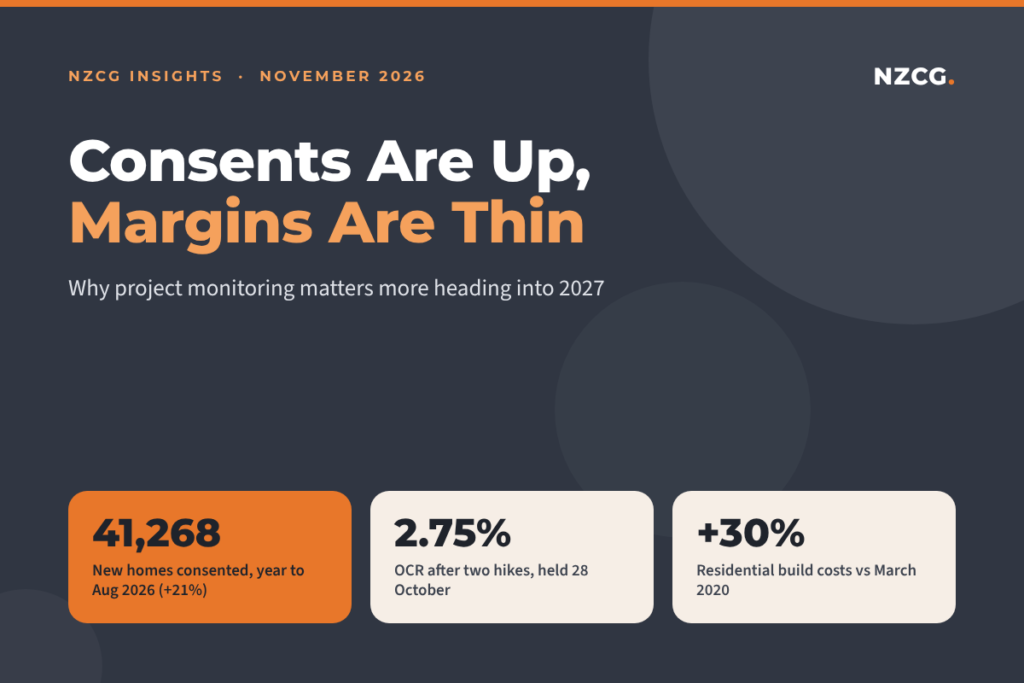
New Zealand’s building pipeline has turned. In the year ended August 2026, 41,268 new homes were consented nationally, up 21% on the year before, with stand-alone houses and multi-unit homes both lifting by around a fifth. After three years of contraction, that is welcome news for builders, subcontractors and suppliers. The conditions that will decide whether those projects make money, however, look very different from the last upswing.
The Reserve Bank lifted the Official Cash Rate twice this year, to 2.50% in July and 2.75% in September, then held it at 2.75% on 28 October. Residential build costs are now around 30% higher than in March 2020, and fuel and materials pressure linked to global conflict has kept escalation firmly on the agenda. Non-residential consents, meanwhile, slipped 2.9% to $8.8 billion in the year ended June 2026. More work, dearer money and creeping costs: that combination rewards the teams who know exactly where every project stands, every week.
1. Volume Is Back, Certainty Is Not
Hubexo’s 2026 outlook described an industry where discipline has replaced volatility, with only projects carrying manageable risk moving forward and deferrals still elevated. That discipline at feasibility stage now has to carry through into delivery. A project that pencilled at a 6% margin early in the year can lose half of it through a few months of unrecorded variations, a slow claim cycle, or a programme that drifts past a funding milestone.
The monthly figures also show the recovery is uneven. New dwelling consents fell month-on-month in May, June and July 2026, even as the annual total kept climbing. Pipeline confidence and cash certainty are not the same thing.
2. Where Projects Actually Lose Money
Across more than 70 projects, the NZCG team has rarely seen margin disappear in a single event. It leaks, usually through some combination of the following:
- Variations instructed on site but priced weeks later, or never formally notified.
- Cost reports that look backwards from invoices, rather than forwards from commitments.
- Progress claims that are thinly documented, inviting reductions and slower payment.
- Programme slippage that is noticed but never costed, so time-related preliminaries quietly blow out.
- Contingency drawn down without a clear record of what it was spent on.
None of these are failures of building. They are failures of visibility.
3. What Good Monitoring Looks Like Heading Into 2027
Good project monitoring is not a thicker monthly report. It is a short list of live signals, each with a clear point at which someone acts. The triggers below are indicative ones we use; every project should set its own.
| Signal | What To Track | When To Act |
|---|---|---|
| Cost to complete | Committed cost plus forecast against budget, by trade package | Forecast overrun on a package exceeds the contingency allocated to it |
| Variations | Register of instructed, notified, priced and approved changes | Any instructed variation still unpriced after 10 working days |
| Programme | Planned versus actual on critical path activities | More than a week of critical path float consumed |
| Cash flow | Claimed, certified and paid values against forecast | Certified value more than 10% below claimed, two months running |
| Escalation | Key material and labour rates against tender assumptions | Movement beyond the allowance carried in the price |
The value is not in the spreadsheet; it is in the weekly conversation it forces between site, commercial and client. Under NZS 3910 and similar contract forms, notice provisions and time limits mean a variation identified late can easily become a variation lost.
4. Price 2027 Work On 2027 Costs
With cost growth trending back towards long-run averages and borrowing costs rising, tenders priced on today’s rates for work starting mid-2027 carry real exposure. Before signing, check whether the contract includes price fluctuation provisions, how escalation is allowed for in fixed-price work, and how much contingency is genuinely held rather than assumed. Funders and clients are asking harder questions, and a clear, current cost-to-complete is now a large part of the answer.
The Road Ahead
2027 looks set to bring more activity than 2025 or 2026, but not easier activity. Contractors and developers who treat commercial management as a weekly discipline, rather than a month-end report, will be better placed to protect margin, keep funders onside and resolve disputes before they start.
NZCG’s Consulting team provides project monitoring, cost reporting and commercial management for contractors, developers and clients across New Zealand. For the wider economic and sector picture, download our free Industry Outlook Report 2027 at nzcg.nz/industry-outlook.
Sources
- Stats NZ, building consents issued, year ended August 2026 (via Trading Economics)
- Stats NZ, monthly new dwelling consents May to July 2026 (via Trading Economics)
- Reserve Bank of New Zealand, OCR held at 2.75%, 28 October 2026
- Calculate.co.nz OCR history, July and September 2026 decisions
- Cotality, Cordell Construction Cost Index Q1 2026 (NZ Property Market Podcast)
- PlaceMakers Under Construction, Consents pass 40k for first time since 2023, 17 August 2026
- Hubexo, Discipline Replaces Volatility: New Zealand’s Construction Outlook for 2026
- NZ Adviser, NZ housing consents rise 11% as sector rebounds (Westpac commentary on fuel and materials costs)